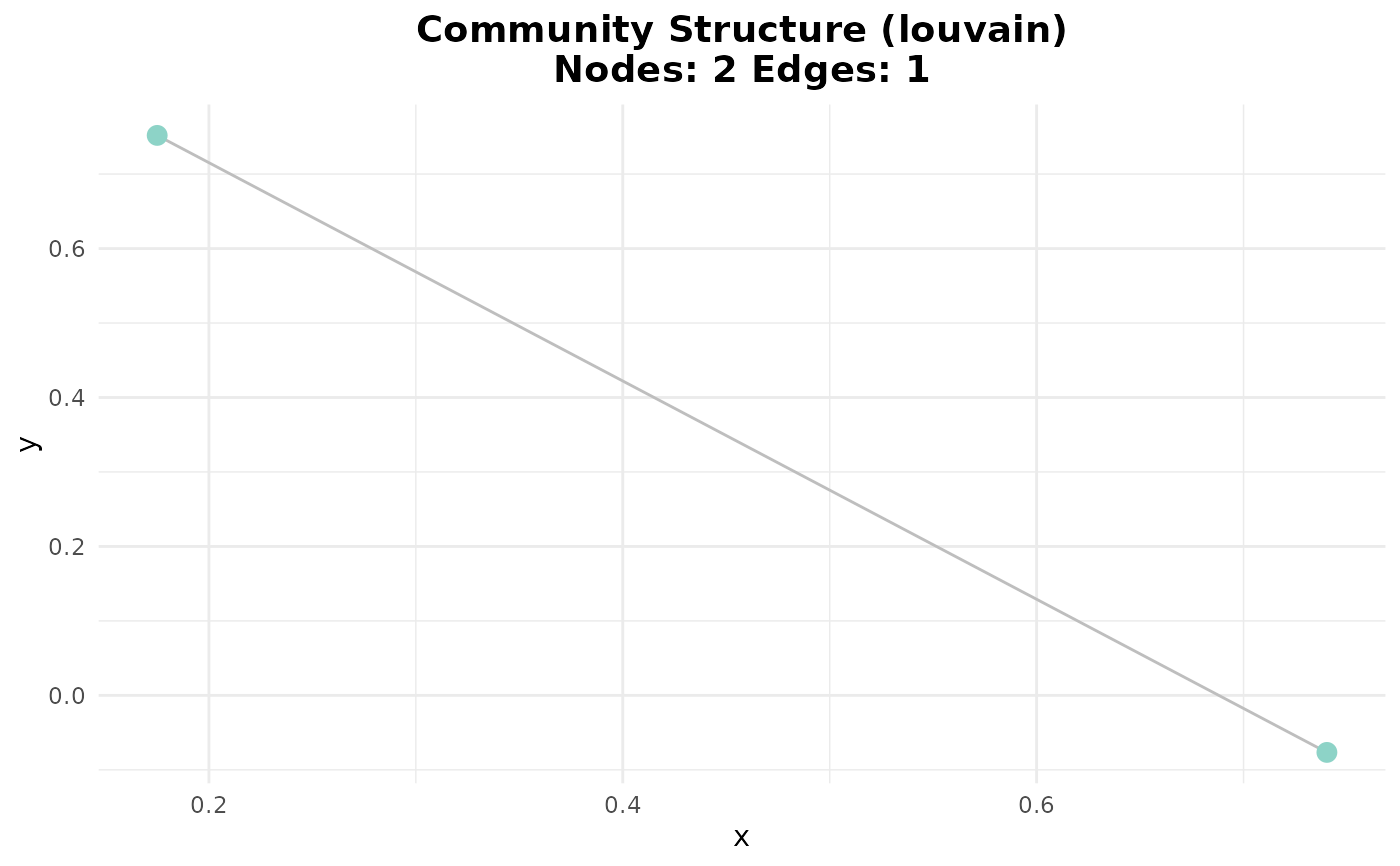
Detects gene communities within an adjacency network using one or two community detection methods, and performs pathway enrichment for each detected community.
Arguments
- adj_matrix
A square adjacency matrix or a SummarizedExperiment object containing a single adjacency matrix. Row and column names must correspond to gene symbols.
- methods
A character vector of one or two community detection methods supported by robin. If two are given, performance is compared and the best is selected. Default:
"louvain".- pathway_db
Character string specifying the pathway database to use:
"KEGG"or"Reactome". Default:"KEGG".- organism
Character string specifying the organism:
"human"or"mouse". Default:"human".- genes_path
Integer. Minimum number of genes per community to run enrichment analysis. Default:
5.- plot
Logical. If
TRUE, generates a plot of detected communities. Default:TRUE.- verbose
Logical. If
TRUE, shows progress messages. Default:TRUE.- method_params
List of parameters for community detection methods. Common parameters include:
resolution: Resolution parameter for Louvain/Leiden (default: 1)steps: Number of steps for Walktrap (default: 4)spins: Number of spins for Spinglass (default: 25)nb.trials: Number of trials for Infomap (default: 10)
- comparison_params
List of parameters for robin comparison:
measure: Stability measure ("vi", "nmi", "split.join", "adjusted.rand"). Default: "vi"type: Robin construction type ("dependent", "independent"). Default: "independent"rewire.w.type: Rewiring strategy for weighted graphs. Default: "Rewire"
- BPPARAM
BiocParallel backend for parallel processing. Default:
BiocParallel::bpparam().
Value
A list with elements:
communities: List withbest_methodand a named vector of community membership per gene.pathways: List of enrichment results per community (only for communities meeting size threshold).graph: The igraph object with community annotations.
Details
If two methods are provided, the function uses
robinCompare and selects the method with higher AUC. Pathway
enrichment is done via clusterProfiler (KEGG) or via
ReactomePA (Reactome). Communities smaller than
genes_path are excluded.
Examples
data(toy_counts)
# Infer networks (toy_counts is already a MultiAssayExperiment)
networks <- infer_networks(
count_matrices_list = toy_counts,
method = "GENIE3",
nCores = 1
)
head(networks[[1]])
#> regulatoryGene targetGene weight
#> 1 HLA-B FTL 0.2045461
#> 2 CD74 CXCR4 0.1579789
#> 3 HLA-A HLA-B 0.1547400
#> 4 HLA-B HLA-A 0.1519506
#> 5 FTL FTH1 0.1423699
#> 6 FTH1 FTL 0.1396498
# Generate and symmetrize adjacency matrices (returns SummarizedExperiment)
wadj_se <- generate_adjacency(networks)
swadj_se <- symmetrize(wadj_se, weight_function = "mean")
# Apply cutoff (returns SummarizedExperiment)
binary_se <- cutoff_adjacency(
count_matrices = toy_counts,
weighted_adjm_list = swadj_se,
n = 1,
method = "GENIE3",
quantile_threshold = 0.95,
nCores = 1,
debug = TRUE
)
#> [Method: GENIE3] Matrix 1 → Cutoff = 0.06602
#> [Method: GENIE3] Matrix 2 → Cutoff = 0.06785
#> [Method: GENIE3] Matrix 3 → Cutoff = 0.06985
# Create consensus (returns SummarizedExperiment)
consensus <- create_consensus(binary_se, method = "union")
# community_path now accepts SummarizedExperiment objects directly
comm_cons <- community_path(consensus)
#>
#>
#> Detecting communities...
 #> Running pathway enrichment...
#> 'select()' returned 1:1 mapping between keys and columns
#> Reading KEGG annotation online: "https://rest.kegg.jp/link/hsa/pathway"...
#> Reading KEGG annotation online: "https://rest.kegg.jp/list/pathway/hsa"...
#> kegg_category.rda is not found, download it online...
#> 'select()' returned 1:1 mapping between keys and columns
#> 'select()' returned 1:1 mapping between keys and columns
#> 'select()' returned 1:1 mapping between keys and columns
#> Running pathway enrichment...
#> 'select()' returned 1:1 mapping between keys and columns
#> Reading KEGG annotation online: "https://rest.kegg.jp/link/hsa/pathway"...
#> Reading KEGG annotation online: "https://rest.kegg.jp/list/pathway/hsa"...
#> kegg_category.rda is not found, download it online...
#> 'select()' returned 1:1 mapping between keys and columns
#> 'select()' returned 1:1 mapping between keys and columns
#> 'select()' returned 1:1 mapping between keys and columns